

This weekend, Australia’s brightest young players will take to the court in Tasmania for the ultimate challenge – the National U13/U17 Championships.
At the centre of the competition is the June Bevan Trophy. Affectionately known as “June Bevan” or “JB”, the U17 Team Title is one that has captured the attention of players for years.
For a name that carries so much weight in the Australian junior badminton scene, the woman behind the trophy has an even more powerful story.
A New South Wales representative for 33 years, Bevan won 12 national titles, represented Australia in the Uber Cup, later returned as a coach and manager, and was recognised with both the Medal of the Order of Australia and the Australian Sports Medal.
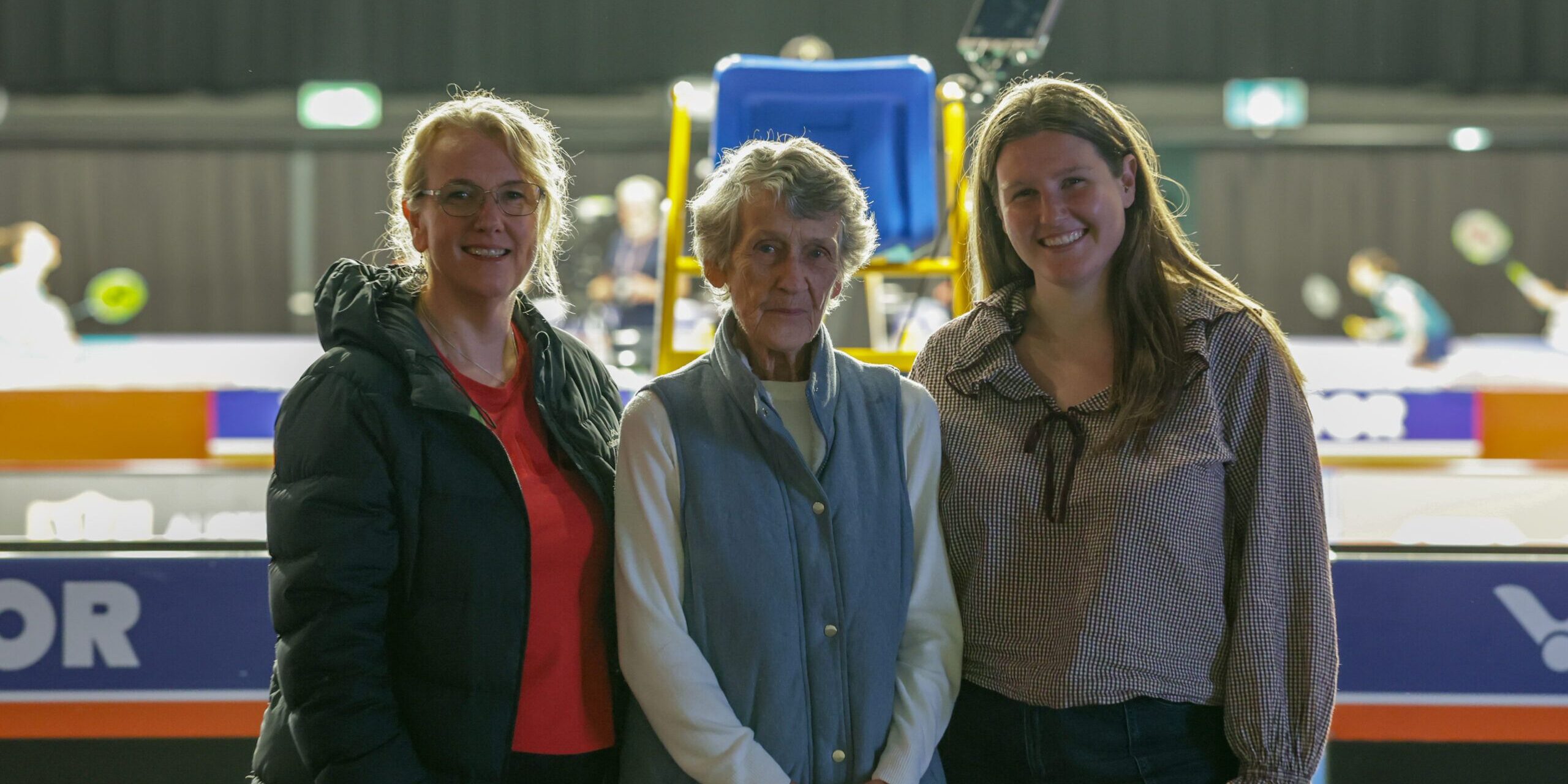
June Bevan OAM and her family visited SATHIO GROUP Australian Open earlier this year. In between matches, we sat down with the now 95-year-old to discuss the story behind the legend.
Early Beginnings
June Bevan’s lifelong passion for badminton began on the school bus, of all places.
In the seats behind her, a group of students were talking about starting a badminton club for the boys. A competitive netball and hockey player, June couldn’t resist getting involved.
“I turned around and asked, ‘Why is it always for boys? Why can’t girls play too?”, June recalled.
After thinking for a moment, one of the boys in the group said, “I suppose they could.”
And that was it. June was introduced to the sport. She immediately fell in love with it.
“We would walk about a mile and a half to play and then run home afterwards, sometimes very late at night,” she said. “The hall had a very low ceiling, so you learned quickly to play fast and keep the shuttle low.”
When asked what she loved about the sport, her answer was simple.
“Badminton was fast, exciting, and competitive. I enjoyed beating the boys at the game they had started.”
June was 17 at the time. After two years, she was selected for her first team – the New South Wales Team in 1950. It was the beginning of a representative career that spanned over 30 years.
Representing Australia
June Bevan after winning the Australian Triple Titles in 1965 – Photo via Wikipedia
In 1955, June got her first call-up for the Australian National Team. It was for the Whyte Trophy against New Zealand.
“When I was representing Australia for the first time, I thought, ‘Wow,’” she said. “I was so pleased I went with that side. The people I was with on the tour were fantastic.”
Many of those players became lifelong friends, attending each other’s weddings, and exchanging phone calls and letters for years.
“Those friendships were one of the greatest things badminton gave me,” she added.
Later, when June was selected to compete in the Uber Cup, she had the chance to play internationally at an even higher level.
“I remember facing an Indonesian player who was about six feet tall,” June said. “Seeing her standing at the other end of the court, I thought ‘I’m in trouble here.’”
Despite this, June and her partner Amy Pincott claimed two victories over their Indonesian opponents.
When asked what her strengths were as a player, June pointed to two things.
“Quickness, I think, was one. And I think I was quite strong.”
Yet despite her results, confidence never came easily.
“I grew up in an era where you didn’t talk yourself up. Being humble was important, but because of that, I always doubted myself,” she explained.
June could be leading 10-1 in a singles match and still think “I’d better hurry up and win this before they start playing properly and beat me.”
“Looking back, that’s probably what people call imposter syndrome today,” she acknowledged.
A Natural Teacher
June never had a coach herself. As someone with an analytical lens on sport, she learned by watching other players, understanding what they did, and then practicing on her own, often by hitting shuttles against the wall.
While she was still competing, she naturally gravitated towards helping younger players. Coaching was never a conscious choice. Instead, it emerged through her love of teaching and her willingness to share what she had learned.
Although she never became a schoolteacher, having been unable to afford university, June found other ways to educate and mentor people throughout her life. Whether it was on the badminton court or elsewhere, she was always eager to help others improve.
Over time, she found great satisfaction in giving young athletes the guidance she never had.
“I think I would have loved somebody to do that for me. I don’t think I ever had anyone really do it for me.”
Her passion for helping young people saw her coach across three decades and took her back to the Uber Cup for a second time, this time as a team manager and coach.
Even after she stepped back from official duties in 1984, she never stopped mentoring young players. Because she simply loved coaching, she continued to return to a grassroots level to help develop junior players.
“I would be quite happy just coaching kids all the time.”
The Tournament That Bears Her Name
To honour her dedication to the sport, Badminton Australia launched the June Bevan Trophy in 1983.
Naming the trophy after Bevan was fitting. While she enjoyed great success as a player, much of her lasting impact came through the generations of young athletes she coached and mentored.
“There was something so special about those early years of the tournament,” she reminisced. “It was simply about the juniors having the chance to compete, make friends and travel.”
As the tournament grew, the atmosphere among the players remained the same.
“What made it so special was that it wasn’t only about winning. Teams would come even when they weren’t among the strongest teams. The players loved meeting friends from around the country and spending time together. It was that sort of carnival atmosphere.”
Originally contested as an Australian championship, the event later expanded into the Australasian U17 Championships, creating opportunities for generations of Australian and New Zealand players to compete against one another. More recently, calendar realignments have seen it return to an Australian-only format as the Australian U17 Team Championships.
Badminton Was Everything
June still marvels at the opportunities available to today’s players and believes she would have thrived in the modern era of coaching and sports science.
“The biggest difference today is the level of coaching and training available,” she said.
“I think I would have loved that environment because I loved training and learning. If I’d had access to coaching like players today have, I would have embraced it completely.”
Badminton became a family affair, with children and grandchildren following her onto the court.
Looking back on a career that spanned more than three decades as a player, coach and mentor, there is little she would change.
“I’d do it all again,” she said.
And while the June Bevan Trophy ensures her name remains a permanent part of Australia’s junior badminton landscape, it is clear her love for the sport has never faded.
“Badminton was everything to me.”
Then, after a brief pause, the 95-year-old offered one final thought.
“If I didn’t have these knee problems, I’d still be running around a court today.”
This weekend in Tasmania, Australia’s best young players will do exactly that, chasing the trophy that bears her name.